The Competence Trap: Why Highly Capable People Stay in Roles That No Longer Fit
Many midlife professionals stay in positions they have already mastered. Not because they lack options. Not because they have lost ambition. And not because they are incapable of more.
They stay because competence is rewarding. When you are good at what you do, people trust you. They rely on you. They come to see you as steady, proven, and valuable. Over time, that trust becomes reputation. Reputation can become identity. Eventually, what once felt like success can start to feel like a kind of confinement.
You know how to do the work. You know how to carry the expectations that come with it. You know how to succeed in the role because you have already done it, repeatedly.
But at a certain point, the question changes. The question is no longer, Can I do this well? It becomes, Is this still where I am supposed to grow?
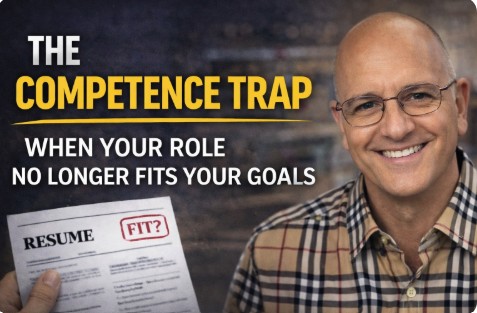
That is the competence trap.
It happens when a role that once stretched you now mostly depends on what you already know. You may still be performing at a high level, but your role is no longer stretching or challenging you in ways that are helping you grow into the next phase of your professional trajectory. It may no longer be moving you toward the goals that matter most now. It may simply be rewarding the version of you that was built for an earlier chapter.
That is where many capable people get stuck. They confuse being effective with being aligned. They confuse being respected with being called forward. And because nothing looks obviously broken from the outside, they often stay longer than they should.
From a coaching perspective, this is one of the more important midlife leadership issues to name clearly. High performers can live with a fair amount of comfort. There is nothing wrong with that. But they still need challenge. They still need growth. They still need meaningful opportunities that feed the inner desire to keep developing. Without that, even success can start to feel flat.
Competence creates safety. People know what to expect from you. You know what to expect from yourself. There is less uncertainty, less risk, and often more authority. For a season, that can feel deeply satisfying.
But comfort has a downside when it stops being a platform and starts becoming a ceiling.
Once you become known for doing something well, people tend to keep you in that lane. They keep handing you the same kinds of problems, the same kinds of responsibilities, the same place in the system. The organization benefits from your consistency. You benefit from the credibility you have earned.
What often gets missed is that growth rarely happens by repeating only what is already proven. Growth happens when your strengths are still useful, but no longer sufficient on their own. It happens when you are asked to think differently, lead differently, or build capacity you have not had to build before.
The trap is not competence itself. The trap is becoming so identified with a role you have mastered that you stop asking whether it still fits the person you are becoming.
The first sign you may be in the competence trap is that you are still producing, but you are no longer growing. Your performance may still be strong. You may still be highly respected. You may still be the person others count on. But the work is no longer requiring much of you that is new.
You are operating from known strengths, familiar patterns, and established expectations. The role may still be demanding. It may still be tiring. But effort is not the same as growth. Being busy is not the same as being developed.
This is where high performers can fool themselves. They assume that because the days are full and the work is hard, they must still be moving forward. Not always.
A better question is this: What is this role asking me to become now that I was not already six years ago? If the honest answer is not much, pay attention.
The second sign is that your reputation is making the decision for you. This is where identity starts to matter.
You become known as the dependable one. The strategic one. The stabilizing one. The person who can handle pressure, complexity, or uncertainty without creating more of it. Those are real strengths. They matter. But they can also become restrictive when everyone around you keeps reinforcing the same version of you.
At that point, staying can start to feel responsible, even honorable. But sometimes what looks like commitment is really attachment to being known a certain way.
I have seen this with leaders who are admired, successful, and outwardly stable. One in particular had built a strong reputation inside her organization. She was the person people trusted to steady things when conditions got difficult. She was excellent at it. But after years in the same kind of role, she began to realize that what once felt meaningful now felt overly familiar. Nothing was wrong on paper. She was still performing. Others still valued her. But privately, she knew she was no longer being challenged in a way that matched where she wanted to go. The hardest part was not admitting she needed something more. The hardest part was admitting that the role had become part of her identity. Once she could name that clearly, her decision-making improved.
That is often how this works. The issue is not laziness or ingratitude. The issue is that earlier success can become powerful evidence against necessary change.
A useful question here is simple: If I were choosing fresh today, with what I know now about myself, would I choose this exact role again? Not five years ago. Not when it first made sense. Today. That question has a way of cutting through performance, loyalty, and habit.
The third sign is that the idea of change feels threatening in a deeply personal way. Most high performers are not afraid of hard work. They have already proven they can work hard.
What often feels threatening is something more subtle: loss of credibility, loss of certainty, loss of being the one who knows, loss of status, loss of identity. Starting over, even partially, can feel expensive after years of building mastery.
So people tell themselves they are staying because it is practical. Sometimes that is true. Sometimes it is wise. But sometimes they are staying because the current role protects a familiar self-concept.
That is not a small thing. It is often the thing.
When people say they are too busy to think about what comes next, I take that seriously. But I also know that busyness can become a form of protection. The full plate becomes a reason not to examine whether the plate still holds the right things.
A helpful exercise is to block two hours and seriously explore one alternative. Not to commit. Not to announce anything. Just to engage it honestly. Research a different path. Reimagine your current role. Have one strategic conversation with someone you trust.
Then notice what happens in you. Did the exercise drain you? Did it expose fear? Did it create relief? Did it wake something back up? That response is data.
This is where clearer thinking matters. Real commitment sounds like this: I am choosing this role because it still aligns with what I value, where I want to grow, and how I want to contribute.
Identity protection sounds like this: I am staying because this role has become too intertwined with how I see myself and how others see me.
From the outside, those two realities can look almost identical. The same title. The same responsibilities. The same level of professionalism. The same successful appearance. Internally, they are very different.
One feels intentional. The other feels defended.
That distinction matters because many capable adults are not trapped by the work itself. They are trapped by the meaning they have attached to continuing to be the person they have been.
And that is exactly why this conversation belongs in midlife. By this stage, most people have enough experience to know what they are good at. The more important question is whether what they are good at is still the right place to keep investing their best energy.
If you suspect you may be in the competence trap, slow the situation down and ask three questions. Is this role still challenging me in ways that are helping me grow, or is it mostly rewarding what I have already mastered? Am I staying because this work still fits who I am becoming, or because it protects the identity I have built? If I stay on this path for the next three years, will I be proud of how I developed, or mostly satisfied that I stayed competent and relevant?
Write your answers down. Do not rush them. Do not edit them to sound sensible. Just tell yourself the truth.
Then take one more step. Identify one experiment you can run in the next 30 days. That experiment might be a conversation with your manager about expanding or redesigning part of your role. It might be volunteering for a different kind of challenge. It might be exploring a lateral move, a broader scope, or a more meaningful direction outside your current lane.
The point is not to make a dramatic decision too fast. The point is to stop drifting inside a role that no longer deserves your automatic yes.
The real issue is not comfort. It is stagnation dressed up as success.
Comfort is not always a problem. A high performer does not need to feel stretched every minute of every day. There is nothing wrong with steadiness, rhythm, or confidence. In many seasons, that stability is earned and useful.
But when comfort becomes the defining feature of your professional life, and challenge starts disappearing, growth usually goes with it.
That is when competence begins to cost you. Not all at once. Quietly.
You become less curious. Less energized. Less connected to a larger future. You keep delivering, but something in you knows you are no longer being called into your next level.
That matters. Because a healthy career is not built only on proving you can continue doing what you already know how to do. It is built on continuing to grow into what is next.
This is a pattern I see often in coaching. A capable person comes in still functioning at a high level. They are respected. They are producing. From the outside, things look stable and successful. But internally, something feels flat, overly familiar, or tight.
Usually the problem is not that they have failed. The problem is that they have outgrown a role, a standard, or an identity and have not yet given themselves permission to say so.
That is where the work begins. We get clear about what is actually happening. Is this burnout? Misalignment? Underused strengths? Fear of change? A role that no longer supports the next stage of growth?
Then we move from vague dissatisfaction to specific decisions. What needs to be challenged again? What needs to be redefined? What needs to be left behind?
That kind of clarity matters because midlife is not the time to drift on autopilot inside a role you mastered years ago. It is the time to make sure your experience is still moving you forward.
If this article feels familiar in a way that is hard to ignore, pay attention to that. You do not need to make a dramatic move tomorrow. But you may need to stop assuming your current role still deserves your future. If you are ready to think clearly about what fits now, coaching is a good place to start.


