Age Of Advantage Blog Spot

The Problem With Passion

The Problem With Passion

The Problem With PassionBrett Antczak

This blog challenges the common belief that passion should be the primary driver of purpose and direction in adulthood. While passion can be powerful earlier in life, it is inherently unstable and fades as responsibilities deepen, novelty wears off, and emotional capacity changes. The post argues that waiting for passion to lead in midlife often results in stalled progress and unnecessary self-doubt. The blog distinguishes between interest, engagement, and meaning—three experiences often mistakenly bundled together. Interest is temporary curiosity, engagement is focused attention, and meaning is coherence between values, identity, and action. Passion tries to carry all three and eventually collapses under that weight. Rather than chasing emotional intensity, the post reframes commitment as a quieter, more durable force. Mature commitment is grounded in clarity, values, and sustainability, not constant motivation or enthusiasm. By designing commitments that work even on ordinary days, readers are encouraged to stop waiting for feelings to return and start building structures that support long-term fit, progress, and stability.

Dream Buildling
The Hidden Cost of Being Highly Competent

The Hidden Cost of Being Highly Competent

The Hidden Cost of Being Highly CompetentBrett Antczak

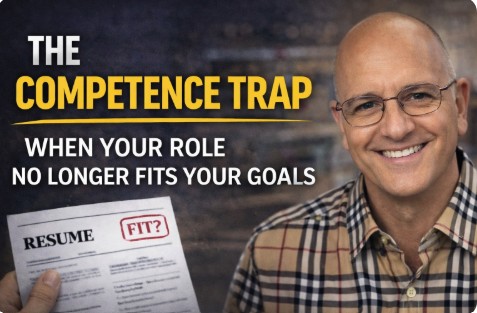
Competence is usually seen as an unqualified strength. Being capable, reliable, and intelligent tends to create success, stability, and opportunity. But over time, competence can quietly become a trap. Not because it stops working, but because it works so well that it creates inertia. You get good at something, people rely on you for it, and soon your identity becomes fused with that role. A life forms around what you are effective at, not necessarily what you consciously chose. This is why highly capable people often feel especially stuck. Their lives look good from the outside, with no obvious crisis or failure to justify change. Responsibility, income, expertise, and reputation become anchors. Walking away feels irrational or irresponsible, even when something inside feels misaligned. So instead of asking whether the life still fits, the question becomes how to tolerate it better. The deeper issue is the difference between capability and authorship. Capability is about what you can do. Authorship is about what you are choosing. Many people are living lives built almost entirely on their usefulness, shaped by momentum rather than intention. The hidden cost of being highly competent is not burnout, but unconsciousness—realizing your strengths may now be limiting your freedom to design a life that truly reflects who you are.

Dream Buildling
You Don’t Lack Time. You Lack a Coherent Life System

You Don’t Lack Time. You Lack a Coherent Life System

You Don’t Lack Time. You Lack a Coherent Life SystemBrett Antczak

This blog reframes the common midlife complaint of “not having enough time” as a design problem rather than a personal shortcoming. It argues that time scarcity is usually the result of a fragmented life system, where multiple roles and competing priorities operate without a unifying structure. As responsibilities accumulate, energy is lost through constant context-switching and unresolved decisions, making even well-managed days feel rushed and exhausting. The post explains why productivity hacks often fail at this stage of life. Efficiency applied to a misaligned system only accelerates burnout, helping people move faster between competing demands without addressing the underlying problem. The real issue is not how quickly tasks are completed, but what life is organized around. The blog introduces the idea of designing a coherent life system built on a few central organizing principles. These principles act as decision filters, reducing friction and clarifying priorities. When roles are aligned rather than competing, time feels more spacious, energy stabilizes, and life regains a sense of direction and meaning.

Dream Buildling
Optionality: The Real Currency of Midlife

Optionality: The Real Currency of Midlife

Optionality: The Real Currency of MidlifeBrett Antczak

This blog reframes midlife as a stage where flexibility matters more than certainty. Earlier in life, committing fully to a clear path often creates stability and progress. Over time, however, those same commitments can limit movement and increase vulnerability when circumstances change. The post introduces optionality as the real currency of midlife—the ability to adapt intelligently rather than react under pressure. Psychologically, optionality reduces the anxiety that comes from feeling trapped in a single role, income stream, or identity. Strategically, it creates leverage by preserving multiple ways to express value and move forward. The blog explains how over-commitment quietly destroys future freedom, not through failure, but through rigidity and accumulated obligations. Rather than encouraging chaos or constant reinvention, the piece emphasizes designing option-rich structures: investing in transferable skills, protecting discretionary time, and avoiding single points of failure. Decisions are reframed as choices that should be evaluated by how many degrees of freedom they preserve or create. In midlife, optionality becomes intelligent freedom—and a lasting strategic advantage.

Dream Buildling
Why Most Goals Fail After 40

Why Most Goals Fail After 40

Why Most Goals Fail After 40Brett Antczak

This blog explores why traditional goal-setting often stops working after midlife, even for capable, motivated people. The issue isn’t a lack of ambition or discipline, but that most goal frameworks were designed for earlier life stages focused on proving, building, and pushing through limits. In midlife, emotional load, responsibilities, and nervous system capacity change, yet goals are often set as if those changes never occurred. The post explains how outcome-driven goals ignore identity and emotional capacity, creating a mismatch between ambition and what the system can realistically sustain. When goals require constant self-coercion, they lead to exhaustion rather than growth. What looks like a motivation problem is actually a design problem. The blog reframes effective midlife goals as generators of coherence rather than pressure. These goals align with who someone is now, respect energy and emotional bandwidth, and integrate ambition with sustainability. Instead of asking how much can be achieved, the focus shifts to what kind of effort strengthens rather than depletes—creating progress that can last.

Dream Buildling
The Risk You’re Actually Managing  (And It’s Not the One You Think)

The Risk You’re Actually Managing (And It’s Not the One You Think)

The Risk You’re Actually Managing  (And It’s Not the One You Think)Brett Antczak

This blog challenges the common midlife belief that risk is primarily about money, reputation, or visible mistakes. It introduces a more useful distinction between local risk and systemic risk. Local risk involves short-term, surface-level threats that are easy to see and manage. Systemic risk, by contrast, builds quietly over time through misalignment, rigidity, and structures that no longer fit but are maintained because they feel safe. The post explains how playing it safe can actually increase long-term vulnerability. When decisions are driven by the avoidance of discomfort, flexibility erodes, curiosity narrows, and options slowly disappear. What appears to be stability often masks growing fragility. Rather than encouraging recklessness, the blog proposes designing asymmetric risk—small, intentional bets with limited downside and meaningful upside. In this framework, fear is not treated as an enemy, but as useful information signaling where redesign is needed. The core reframe is clear: midlife isn’t about eliminating risk, but about managing the right kind to build resilience, alignment, and long-term durability.

Dream Buildling