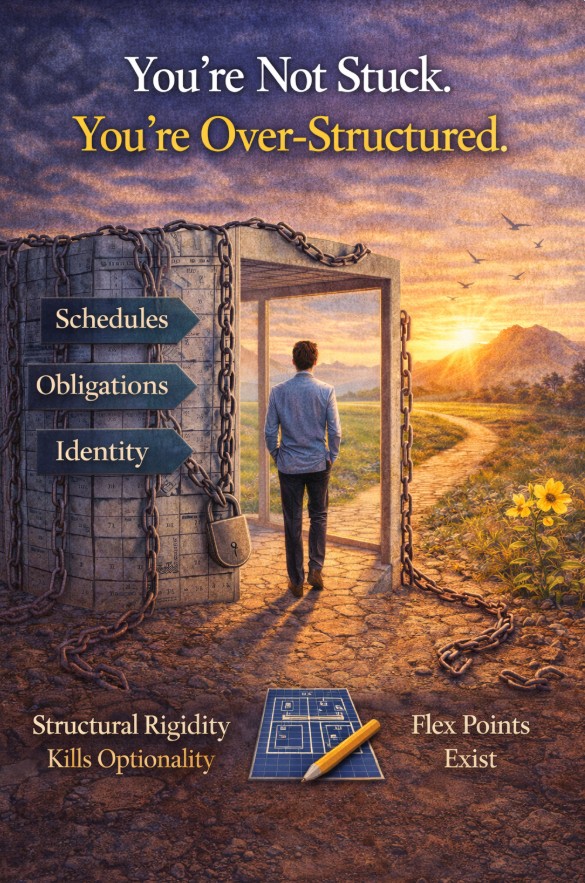
You’re Not Stuck. You’re Over-Structured.
You’re Not Stuck. You’re Over-Structured.
When people say they feel stuck, they usually mean they feel trapped inside a life that no longer fits. The common story is that something is wrong with them: not enough courage, not enough motivation, not enough clarity. But in most midlife situations, the problem isn’t internal paralysis. It’s structural rigidity.
Over time, life becomes what we think is highly optimized. Schedules get full. Roles become fixed. Obligations accumulate. Identity solidifies. You build systems that make everything efficient and predictable—career paths, financial commitments, social expectations, routines that run almost automatically. From the outside, it looks like stability. From the inside, it can feel like compression.
This is what over-structure looks like. Your life is no longer designed for exploration, but for maintenance. Everything has a place, and that’s exactly the problem. There is no slack in the system. No white space. No room for curiosity or recalibration. You are not stuck because you lack options. You are stuck because your life is so optimized for yesterday’s goals that it leaves no capacity for tomorrow’s questions.
Over-optimization quietly kills optionality. When every hour is assigned, every role is defined, and every decision is pre-scripted, change starts to feel impossible. Not because it truly is, but because the system cannot imagine alternatives. Optionality requires looseness. It requires time that isn’t allocated, energy that isn’t exhausted, identity that isn’t frozen.
The key is that most people don’t need radical change. They need flex points.
Flex points are small areas where structure can be softened without destabilizing the entire system. It might be one afternoon a week reclaimed from obligation. One role renegotiated instead of fully abandoned. One new project explored without turning it into a life-or-death decision. One honest conversation that creates psychological space even if nothing changes immediately.
These are not dramatic moves. They are strategic ones.
Once you create even a little flexibility, something important happens: agency returns. You stop seeing your life as a prison and start seeing it as a system that can be adjusted. Not all at once. Not recklessly. But intelligently.
You are not stuck. You are simply living inside a structure that was never designed to evolve. The work of midlife is not to escape your life. It is to introduce just enough looseness that it can grow and flex with you again.


