The Architecture of Trust and Accountability
One of the most difficult transitions for a leader moving from Hero Fixer to Architected Sovereign Leader is the shift in how they view accountability. In the Hero stage, accountability is often reactive; it is something that happens after a mistake is made. The leader steps in, fixes the error, and perhaps offers a reprimand. But in the Architect stage, accountability is a structural element designed into the system from the beginning.
When you operate as a Hero, you are essentially practicing rescue-based leadership. You believe that by being the final safety net, you are protecting the organization. In reality, you are eroding the very trust required for a high-performing team member to function. Trust is not a soft internal feeling; in a professional context, trust is the confident expectation of a high performer. When you constantly intervene, you signal to your team that you do not actually expect them to perform.
The High Cost of Low-Trust Environments
In his research on organizational speed, Stephen M.R. Covey notes that trust is the one thing that changes everything. He argues that in low-trust environments, every interaction, every decision, and every project is taxed. Things take longer and cost more because of the hidden tax of bureaucracy and constant oversight. When you are the bottleneck who must approve every minor detail, you are imposing a heavy tax on your organization’s momentum. You act as literal cold molasses in the middle of the workflow.
I see this frequently with leaders who feel they have a talent problem. They complain that their team lacks initiative, skillsets, or ownership of results. However, ownership cannot be given; it can only be carefully curated. If the architecture of your leadership doesn't allow space for others to fail, succeed, learn, and develop on their own merits, they will never gain the ownership muscle. As Patrick Lencioni highlights, the fear of conflict and lack of commitment often stem from a leader who hasn't built a foundation of vulnerability-based trust and a culture of team curation.I believe this also is based in a lack of trust within the leader for themselves as well and the mistrust of their team is the outward expression of the buried inward feeling.
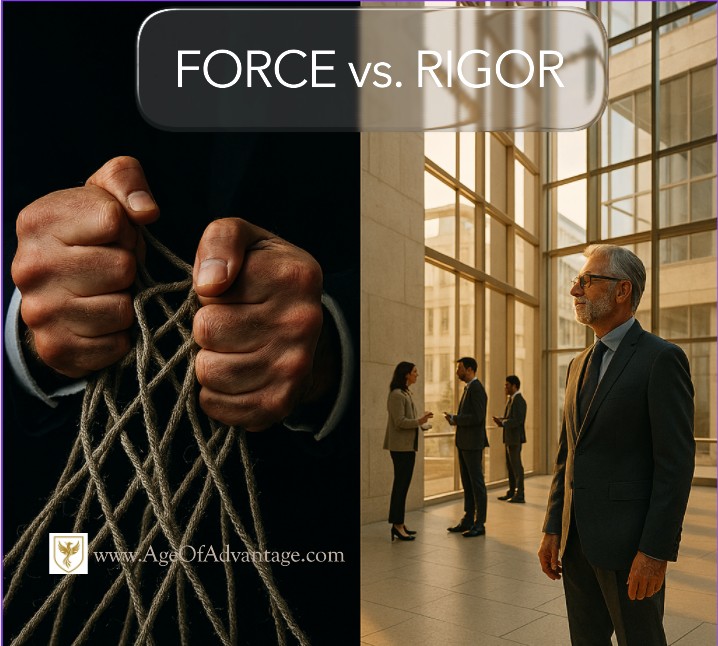
Moving from Force to Rigor
Architecting a Sovereign Leader within yourself requires moving from force using your personal intensity to drive results to rigor. This means using the integrity of your intentional organizational designs to ensure outcomes. Rigor is about setting clear, uncompromising standards and then stepping back to let the system work. This is where many leaders flinch. They confuse stepping back with stepping away.
The Architect is deeply involved, but in a different way. Instead of checking the work, they check the standards. They ask: Does the team have the resources, the clarity, and the authority they need to hit the mark? If the answer is no, the Architect fixes the design, not the person. This approach is supported by David Marquet in Turn the Ship Around!, where he advocates for intent-based leadership. By shifting from giving orders to asking for intent, he transformed a low-performing submarine crew into the best in the fleet. He didn't change the people; he changed the architecture of authority.
The Accountability Loop
Real accountability is a closed loop. It requires a clear hand-off of responsibility and a pre-defined method for measuring success. Most Hero leaders leave these loops open, stepping in halfway through a project because they feel things aren't going well. They then take over, which creates a state of permanent triage where no one is ever truly responsible. The team is left feeling powerless, and eventually mistrusts the process, themselves, and the leader.
The Architect builds a Sovereign Standard. This is a clear agreement on what "done" looks like and who is responsible for getting there. By closing the accountability loop, you free up your mental bandwidth to focus on the future. You stop being a manager of activities and start being a leader of potential.
Reflect on your most recent team project: Did you provide the how or the what? Were you the doer or the Visionary and Sovereign Teacher? If you spent your time prescribing the steps rather than defining the outcome, you were acting as a Fixer. True leadership in the second half of life is about building an environment where excellence is the natural byproduct of the design, not the result of your constant pressure.
Reclaim Your Strategic Command If you keep tolerating a life where you are the bottleneck for your organization and teams, you’ll keep paying in burnout—of your leaders, your teams, and yourself. If you would like to get clear on what matters now and move forward I'm here to help. Details are in my bio.
References
Covey, S. M. R. (2006). The Speed of Trust: The One Thing That Changes Everything. Free Press.
Lencioni, P. (2002). The Five Dysfunctions of a Team: A Leadership Fable. Jossey-Bass.
Marquet, L. D. (2012). Turn the Ship Around!: A True Story of Turning Followers into Leaders. Portfolio.
Sinek, S. (2014). Leaders Eat Last: Why Some Teams Pull Together and Others Don't. Portfolio.


