Why Most Goals Fail After 40
Why Most Goals Fail After 40
For many people, goal-setting stops working somewhere in midlife—and not because they’ve lost discipline or ambition. In fact, the opposite is often true. They’re more capable than ever. More experienced. More self-aware. Yet the goals that once energized them now feel heavy, brittle, or strangely draining.
The problem isn’t motivation. It’s that most goal-setting frameworks were designed for an earlier stage of life.
In younger years, goals tend to be externally oriented. They’re about proving, building, accumulating, and establishing credibility. The nervous system is primed for expansion. Stress is often interpreted as excitement. Sacrifice feels temporary and worthwhile because identity is still forming and capacity is still growing.
By midlife, that context has changed.
Goals that once made sense now collide with a different internal reality. Responsibilities are layered. Energy is finite. Emotional bandwidth is no longer unlimited. The nervous system has lived through enough cycles to recognize when pressure turns into depletion rather than growth.
This is where many people get stuck. They keep setting goals that assume a younger version of themselves—the one who could push indefinitely, override signals, and recover quickly. When those goals stall or collapse, the conclusion is often self-blame: I must be unfocused, lazy, or losing my edge.
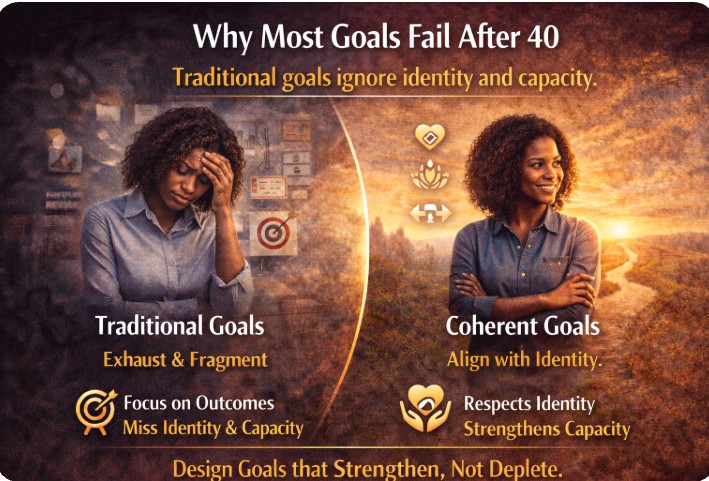
What’s actually happening is a mismatch between ambition and capacity. Traditional goals ignore identity and emotional load. They focus on outcomes without accounting for who you are now, what you’re carrying, and how much strain your system can absorb before coherence breaks down. A goal that looks good on paper but requires constant self-coercion is not a growth strategy. It’s a slow drain.
At this stage of life, effective goals do something different. They generate coherence instead of exhaustion. Coherent goals align with identity rather than fighting it. They respect emotional capacity. They integrate ambition with sustainability. Instead of asking, How much can I achieve?, the better question becomes, What kind of effort strengthens me rather than fragments me?
These goals often look quieter. They prioritize depth over speed, alignment over optics, and progress that compounds without constant pressure. They don’t require you to be someone else to succeed. Rethinking goals in this way isn’t lowering standards. It’s raising intelligence.
If this resonates—if you’ve felt the friction between what you think you should aim for and what your system can realistically support—there is a free Vision Workshop and a complimentary Strategy Call available. They’re designed to help you redesign goals that fit who you are now, clarify what actually matters at this stage, and build momentum without burning yourself out. No hustle narratives. No guilt-based ambition. Just a more accurate way to aim.
At this stage of life, the goal isn’t more force.
It’s better alignment—and goals that can actually carry you forward to live the life you love!


