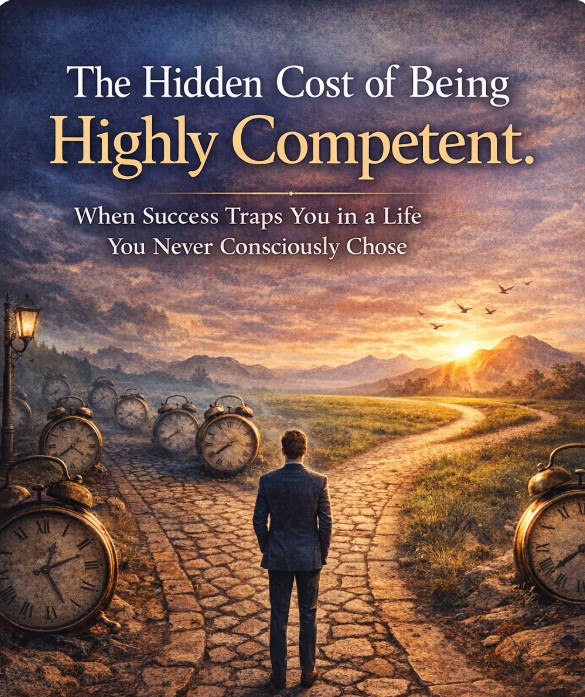
The Hidden Cost of Being Highly Competent
The Hidden Cost of Being Highly Competent
Competence is usually framed as an unqualified good. Be capable, be reliable, be smart, and life will reward you. And for a long time, it does. Competence opens doors, creates stability, earns trust, and builds a reputation. But over time, competence can quietly become a trap. Not because it stops working, but because it works too well.
When you are highly competent, success tends to create inertia. You get good at something, people rely on you for it, and soon your identity becomes fused with that role. You didn’t necessarily choose it consciously. It emerged because you were effective. You solved problems. You stepped up. You delivered. And because it worked, the system around you kept reinforcing the same pattern. Promotions follow. Expectations solidify. A life takes shape that feels logical, respectable, and increasingly difficult to question.
This is why smart, capable people often feel especially stuck. Their lives look good from the outside. There is no obvious crisis, no dramatic failure, no clear reason to leave. In fact, the very things that signal success—responsibility, income, reputation, expertise—become the anchors that make change feel irrational or even irresponsible. Walking away from something you are good at feels wasteful. Doubting a life others admire feels ungrateful. So instead of asking “Is this what I want?” the question quietly becomes “How do I tolerate this better?”
The deeper issue is the difference between capability and authorship. Capability is about what you can do. Authorship is about what you are consciously choosing. Many highly competent people are living lives built almost entirely on capability. They followed opportunities, solved the next problem, accepted the next role, and adapted to what was needed. Over time, the path became automatic. The problem isn’t that they lack freedom. It’s that they stopped exercising it.
Competence creates a powerful narrative: if I’m good at this, I should keep doing it. But being good at something does not mean it deserves to define your life. Skills are not destinies. They are tools. When tools become identities, authorship disappears. You are no longer designing your life. You are maintaining a system that formed around your usefulness.
The hidden cost of being highly competent is not burnout or boredom. It’s unconsciousness. You wake up one day realizing that the life you’re living was assembled by momentum, not intention. Not wrong. Not a failure. Just unchosen.
Midlife is often when this becomes visible, because the external rewards no longer compensate for the internal misalignment. You don’t want to burn everything down, but you also can’t ignore the question anymore: “If I were choosing again today, would I build this?”
Recognizing this is not about rejecting your strengths. It’s about reclaiming authorship. Keeping what still fits. Evolving what doesn’t. And remembering that competence is meant to serve your life—not replace your right to choose it.


