Optionality: The Real Currency of Midlife
Optionality: The Real Currency of Midlife
Earlier in life, certainty feels like the prize. A clear path. A solid plan. A sense that if you commit hard enough and long enough, things will stabilize and stay that way. For a while, that approach works. It builds careers, families, and reputations. But by midlife, many people notice something subtle: the very commitments that once created security now limit movement.
This isn’t a failure of planning. It’s a shift in what actually matters.
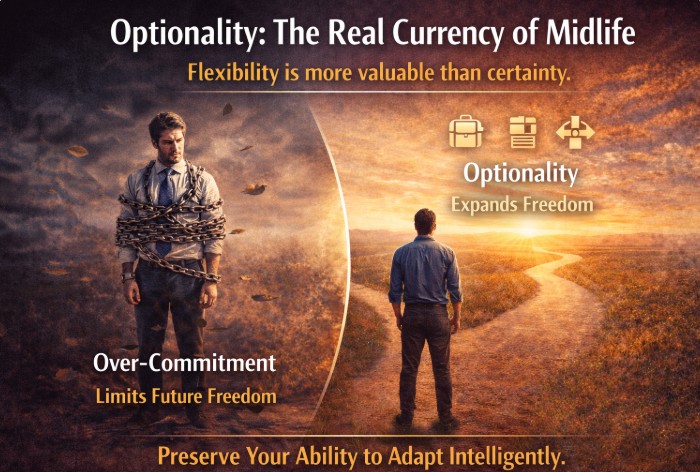
At this stage of life, optionality becomes the real currency. Not in the abstract sense of keeping every door open, but in the deeper sense of preserving the ability to adapt intelligently as conditions change. Optionality is the capacity to respond, not react. To pivot without panic. To choose deliberately instead of being forced by circumstance.
Psychologically, optionality reduces the background anxiety that comes from feeling trapped. When your identity, income, or sense of worth depends on a single narrow path, every disruption feels existential. Flexibility, by contrast, creates steadiness. You’re less brittle because no single outcome carries all the weight.
Strategically, optionality shows up as leverage. It’s having more than one way to express your value. More than one direction your skills could travel. More than one version of a future that would still feel meaningful. This doesn’t require chaos or constant reinvention. It requires thoughtful structure.
Over-commitment is the silent enemy here. Many midlife adults are overcommitted not because they lack discipline, but because they equate commitment with responsibility. They say yes to preserve stability, to avoid disappointing others, or to maintain an image of reliability. Over time, those yeses accumulate into rigidity. Energy gets locked up. Curiosity narrows. Future freedom quietly disappears.
Creating option-rich structures doesn’t mean living unanchored. It means designing your life so no single role, relationship, or outcome becomes a single point of failure. It looks like investing in transferable skills, protecting discretionary time, and making commitments that are deep but not total. It means choosing arrangements that can evolve rather than ones that require constant defense.
The shift is subtle but powerful. Decisions stop being evaluated only by immediate payoff or comfort. They’re measured by how many degrees of freedom they preserve or create. Does this choice expand my ability to adapt in the future, or does it lock me in further?
That question alone changes how midlife is experienced. It replaces pressure with perspective. It turns flexibility into strength, not indecision.
If this resonates—if you sense that what you’re really seeking isn’t more certainty but more room to move—there is a free Vision Workshop and a complimentary Strategy Call available. They’re designed to help you assess where optionality has been lost, where it can be rebuilt, and how to move forward without unnecessary disruption. No forced answers. No dramatic overnight reinvention. Just clearer thinking about how to protect and grow what matters most at this stage of life.
Optionality isn’t avoidance.
It’s intelligent freedom—and it’s one of the greatest advantages of midlife.


