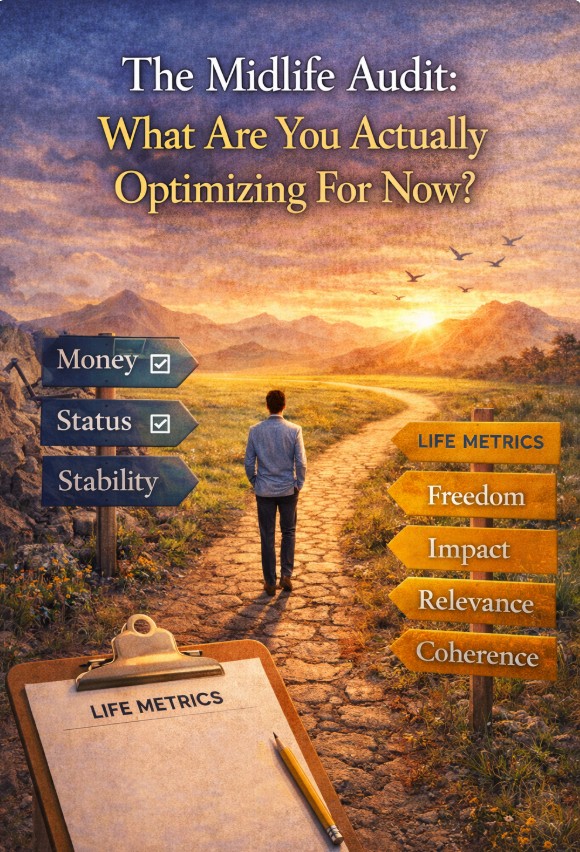
The Midlife Audit: What Are You Actually Optimizing For Now
The Midlife Audit: What Are You Actually Optimizing For Now?
Most people go through life without ever consciously deciding what they are optimizing for. The system is inherited. You absorb the default metrics early on: make money, build status, create stability, be productive, be respectable. These goals aren’t wrong. In fact, they are often necessary. They help you survive, build a foundation, and establish competence in the world.
But very few people ever update the formula.
By midlife, many are still optimizing for the same metrics they adopted in their twenties, even though their values, needs, and identity have shifted. The external game continues, but the internal payoff diminishes. You achieve more, yet feel less satisfied. You stay busy, but less engaged. The system is working, but it no longer feels meaningful.
This is because optimization without reflection eventually becomes misalignment.
Early life metrics tend to be externally validated: income, title, approval, security. They reward performance and comparison. They answer the question, “How am I doing relative to others?” Midlife introduces a different question: “How does this life feel from the inside?”
That shift requires new metrics.
Freedom replaces security as the primary value. Not just financial freedom, but psychological freedom—the ability to choose how you spend your time and attention. Relevance replaces status. Not how impressive you appear, but whether your work actually matters to you and to others. Impact replaces accumulation. Not how much you have, but what effect you’re having. And coherence replaces achievement—the sense that your actions, values, and identity are aligned.
Without updating these metrics, people keep optimizing an outdated system. They push harder toward goals that no longer motivate them and wonder why their energy is fading.
A midlife audit is not about burning everything down. It’s about asking better questions:
What am I currently optimizing for, by default?
Which metrics still feel alive, and which feel inherited?
If I designed my success criteria today, what would I measure instead?
Redefining success doesn’t mean abandoning ambition. It means reclaiming authorship. When you consciously choose what you’re optimizing for, your effort becomes intentional again. You stop chasing numbers that no longer reflect who you are and start building a life that actually fits the person you’ve become.


