The Risk You’re Actually Managing (And It’s Not the One You Think)
The Risk You’re Actually Managing
(And It’s Not the One You Think)
By midlife, most people believe they’ve learned how to manage risk. They watch their finances carefully. They protect their professional reputation. They avoid moves that could look reckless or destabilizing. On the surface, this looks like wisdom earned through experience. But beneath that careful management, another kind of risk often goes unaddressed—and it’s the one that quietly shapes the future.
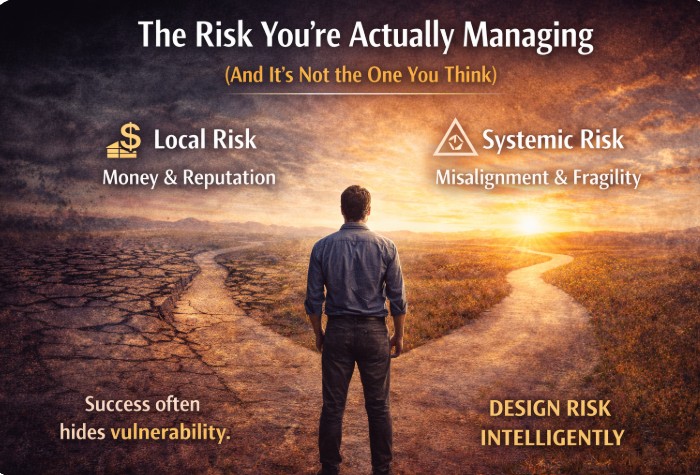
There’s an important difference between local risk and systemic risk. Local risk is immediate and visible. It’s the risk of a bad financial decision, a misstep others might notice, or a choice that temporarily disrupts stability. These risks feel tangible, which makes them easier to justify managing closely.
Systemic risk is harder to see because it doesn’t show up all at once. It builds slowly through misalignment. It looks like staying in roles that no longer fit because they still “work.” It feels like maintaining a life that requires constant effort just to hold together. From the outside, everything appears stable. Internally, flexibility is shrinking.
This is where playing it safe becomes counterproductive. When decisions are made primarily to avoid short-term discomfort, long-term resilience erodes. Skills stop evolving. Curiosity narrows. Optionality quietly disappears. What feels like protection in the moment often increases vulnerability over time by locking you into structures that are increasingly fragile. The alternative isn’t risk-taking for its own sake. It’s designed risk.
Asymmetric risk means placing thoughtful, limited bets where the downside is manageable and the upside is meaningful. It might look like experimenting before committing, reallocating time toward work that builds leverage, or testing new directions without staking your identity on immediate success. These moves don’t require bold leaps. They require intelligent design. In this framework, fear stops being something to eliminate. It becomes useful data. Fear points to areas where something matters and needs to be redesigned—not avoided or overridden.
This stage of life isn’t about eliminating risk. It’s about managing the right one. The real danger isn’t a visible misstep. It’s long-term misalignment that quietly hardens into fragility.
If this reframes something for you—if you sense that the greater risk may be staying where you are without redesign—there is a free Vision Workshop and a complimentary Strategy Call available. They’re designed to help surface systemic risks, clarify alignment, and explore asymmetric moves that fit this stage of life without unnecessary upheaval. No pressure. No bravado. Just clearer thinking and better design.
When fear shows up, it may not be warning you to stop, but a sign you are making changes to move out of your old paradigms


