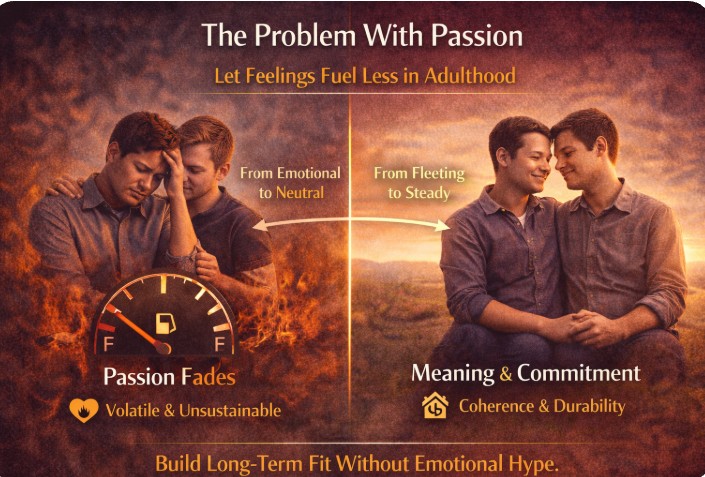
The Problem With Passion
The Problem With Passion
At some point in adulthood, many people start to wonder what happened to their passion. The energy that once came easily now feels sporadic. Work that used to excite them feels neutral. Projects that once felt charged now feel heavy. The usual advice—find your passion, reignite the fire, follow what lights you up—only makes things worse.
Because the problem isn’t that passion disappeared.
It’s that passion was never meant to carry this stage of life.
Passion is intense, emotional, and volatile. It thrives on novelty, urgency, and possibility. In earlier seasons, that volatility can be useful. It helps you take risks, tolerate uncertainty, and push through discomfort while you’re building something new. But over time, the nervous system changes. Responsibilities deepen. Recovery slows. Novelty loses its grip.
Passion fades not because you’ve failed, but because your system has matured. The mistake many midlife adults make is assuming that fading passion means something is wrong—that they chose the wrong path, lost their edge, or need a dramatic reset. In reality, they’re holding themselves to an emotional standard designed for a younger life stage.
Part of the confusion comes from lumping very different experiences into one word. Interest is curiosity. It comes and goes. Engagement is focus and absorption. It can exist even when emotions are neutral. Meaning is coherence—the sense that what you’re doing fits who you are and what you value now. Passion tries to do the work of all three, and eventually collapses under the weight.
Meaning doesn’t need constant emotional intensity. Engagement doesn’t require excitement. Interest doesn’t have to be permanent to be useful. When you separate these, pressure lifts. You stop asking your work, relationships, or goals to emotionally perform for you.
This is where commitment gets redefined. Mature commitment isn’t fueled by feelings. It’s fueled by clarity. It doesn’t rely on motivation spikes or emotional theatrics. It’s built around decisions you can stand behind even on ordinary days. Days when nothing feels especially inspiring—but things still matter.
This kind of commitment is quieter, steadier, and far more durable. It allows progress without drama. It respects energy. It survives mood shifts. And it creates momentum that doesn’t collapse when enthusiasm dips.
At this stage of life, waiting for passion to lead often means waiting indefinitely. Designing commitment based on coherence, values, and capacity is what actually moves things forward.
If this resonates—if you’ve been questioning your direction because the feelings aren’t there like they used to—there is a free Vision Workshop and a complimentary Strategy Call available to help you define your passion. They’re designed to help you clarify what still matters, distinguish between emotional signals and structural fit, and build commitment that doesn’t depend on chasing inspiration and learn to design and live the live you love. No hype. No forced enthusiasm. Just a more accurate way to move forward.
You don’t need more passion.
You need a structure that works even when passion is quiet!


