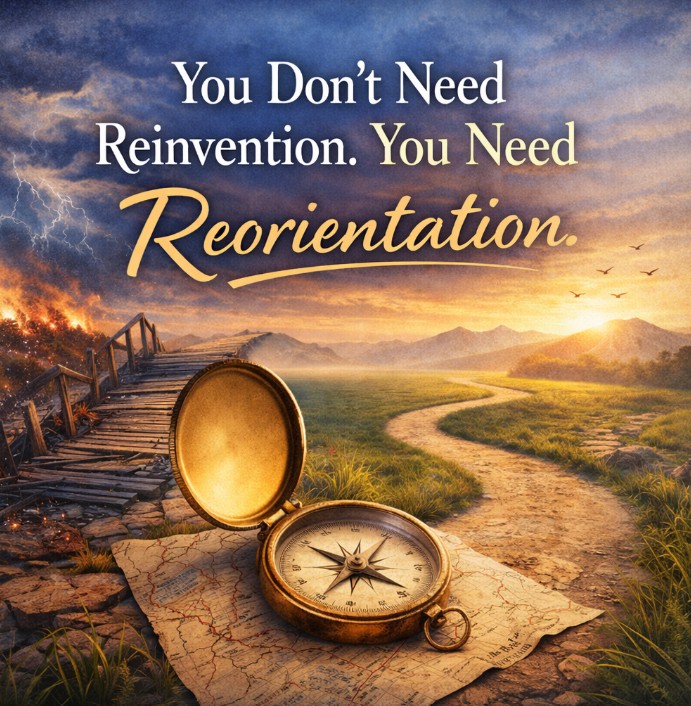
You Don't Need Reinvention. You Need Reorientation.
You Don’t Need Reinvention. You Need Reorientation.
When people hit midlife, the most common advice is “reinvent yourself.” New job. New career. New identity. New everything. It sounds exciting, and in a movie it feels inspiring. But in real life, radical reinvention often creates more panic than clarity, because it assumes we need to demolish what came before and start over.
That assumption is dangerous for one simple reason: you are not broken. What you’ve built — your skills, relationships, wisdom, and habits — matters. Rather than a rupture, midlife is more accurately a reorientation, a calibration of your internal compass to your current self.
Why Radical Reinvention Advice Misses the Mark
The popular notion of midlife crisis — dramatic upheaval, complete life overhaul — rose to public attention in the 20th century but lacks solid grounding as a universal psychological phenomenon. Research shows that only about 10–20% of people experience what looks like a classic “crisis,” while most midlife changes involve reflection and adjustment rather than breakdowns.
Radical reinvention advice promotes a narrative of demolition and rebirth. But most midlife transitions aren’t about starting over; they’re about reassessing identity and context. Psychological theories stress continuity alongside transformation: identity evolves but doesn’t disappear. Narrative identity research shows that adults integrate experiences into an evolving story, not erase the past and begin brand new.
Reorientation: What It Really Means
Reorientation acknowledges who you are and where you’ve been. It focuses on adjustments under real constraints — constraints like financial obligations, family roles, health, and time. It’s strategic rather than dramatic.
Here’s a practical lens:
What to keep: Skills, relationships, achievements, values. These are assets, not liabilities. They anchor your continuity.
What to evolve: Roles and routines that no longer reflect your priorities. Thinking patterns that limit curiosity or growth.
What to release: Expectations that are no longer yours, outdated goals, guilt tied to past choices, unrealistic expectations thrust upon you by society, family, partners and friends.
This approach mirrors how developmental psychology describes midlife: a period of adaptation, reflection, and integration rather than sudden transformation.
The Real Opportunity in Midlife
Reorientation reduces panic and increases agency. Instead of asking “What should I be?” you ask “What do I *value now? What adjustments create coherence between who I am today and how I live every day?”
This simple shift — from radical reinvention to strategic reorientation — turns midlife from a perceived failure point into an opportunity for refinement, alignment, and meaningful growth.
You don’t need to burn everything down. You need to steer with a clearer internal compass.


