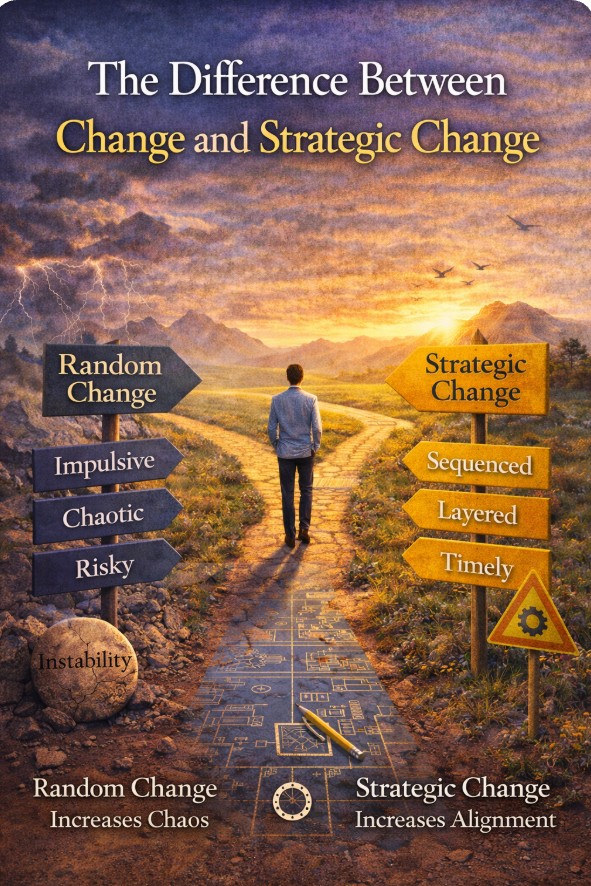
The Difference Between Change and Strategic Change
The Difference Between Change and Strategic Change
Most people think the problem is that they are not changing enough. In reality, the bigger issue is that they are changing without a strategy. When dissatisfaction builds, the instinct is often to make a dramatic move: quit the job, start something new, relocate, blow up the routine. It feels decisive. It feels brave. And in the moment, it feels like relief.
But random change tends to increase chaos, not clarity.
Impulsive pivots are usually driven by emotional pressure rather than thoughtful design. They are reactions, not plans. The energy behind them is often frustration, boredom, or the desire to escape discomfort. While that energy can spark movement, it rarely produces alignment. Instead, it replaces one form of stress with another and leaves people dealing with unintended consequences they never anticipated.
Strategic change is different. It is not about speed. It is about architecture.
Strategic change starts with understanding what is actually misaligned. Not just what feels bad, but what is no longer coherent with your values, identity, and long-term direction. Before changing anything externally, strategic change asks better internal questions: What am I trying to preserve? What am I trying to evolve? What am I trying to stop repeating?
This is where decision architecture comes in.
Decision architecture means designing change the way an engineer designs a system. It involves sequencing—what needs to shift first and what should wait. It involves timing—whether this is the right season for risk or the right season for stabilization. And it involves risk layering—making sure you are not putting all areas of your life into flux at the same time.
Most destabilizing life changes fail because too many variables move at once. Career, identity, finances, relationships, routines—all shifting simultaneously. The nervous system cannot integrate that level of uncertainty. Even positive changes become overwhelming when the foundation is unstable.
Strategic change protects the foundation.
It creates movement without collapse. It allows experimentation without burning bridges. It respects real constraints instead of pretending they don’t exist. You might explore a new direction while keeping your income stable. You might redefine your role before redefining your entire identity. You might test a new life rhythm before making irreversible commitments.
The goal is not to avoid risk. It is to distribute it intelligently.
Random change asks, “How do I escape this?” Strategic change asks, “How do I realign this without destroying what still works?”
That shift alone transforms how change feels. Instead of panic, there is agency. Instead of urgency, there is design. Instead of chaos, there is coherence.
Strategic change does not promise instant relief. It offers something better: sustainable progress that does not require your entire life to be in crisis first.


