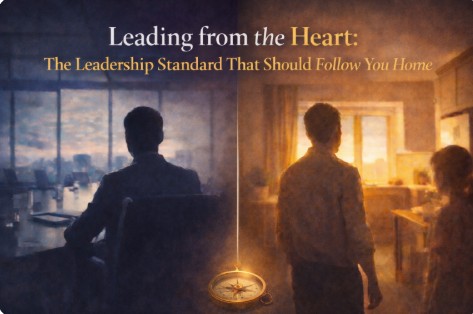
Heart Centered Leadership: The Leadership Style That Follows You Home
Leading from the heart is not a leadership “style,” and it is not a synonym for being soft. It is a standard: staying human while you make hard calls. Most leaders who reach for this are not short on competence. They are short on contact. Under pressure they slip from principle into protection, and the cost shows up as tighter control, less trust, and a quieter team. That posture often follows you home, where you start answering like a manager instead of a person.
Picture a regular meeting in the conference room, and the meeting ends. Someone asks for a decision you already made, and a director says, “Just tell us what you want and we’ll do it.” You feel your shoulders rise. Your voice wants to sharpen, because speed feels safer than presence. In that moment, leading from the heart does not mean you emote more. It means you return to values before you return to the agenda. Quint Studer is blunt: “To be an effective leader, you must be trustworthy. If people don’t trust you, they won’t follow you.” Trust is the result of consistent, principled behavior.
Research points to the same mechanism. Daniel Goleman argues in Harvard Business Review that emotional intelligence is the “sine qua non” of leadership. In practice, that is reading the room, regulating yourself, and responding with clarity. That sequence keeps authority from turning into threat. Protection leads to control, control leads to distrust, distrust leads to dependence, and then you become the bottleneck you were trying to avoid.
This standard shapes whether people speak up and bring you bad news early. Amy Edmondson’s work on psychological safety describes a shared belief that it’s safe to take interpersonal risks, like asking questions or admitting mistakes. When safety is low, people hide problems. When safety is high, they surface issues sooner. The heart matters here: it lowers the cost of truth.
At home, the signals are quieter but more immediate. Your tone changes. You get short. You move into correction mode when what’s needed is presence. With family there is no professional distance to hide behind, so the feedback comes fast: a withdrawn partner, a child who shuts down, or a moment that feels heavier than it needs to be. Leading from the heart at home looks like honesty without harshness, boundaries that protect connection, and truth delivered early. It also means saying, “That wasn’t how I wanted to show up,” and repairing rather than defending.
Brené Brown captures the edge: “Our ability to be daring leaders will never be greater than our capacity for vulnerability.” Taken seriously, that is not oversharing. It is refusing to outsource courage to your title.
If you want this to be more than an inspiring idea, treat it like an operating standard. When you feel yourself tightening, pause long enough to choose principle over ego protection.
References: Goleman (HBR, 2004); Edmondson on psychological safety; Brown, Dare to Lead; Studer on trust.


