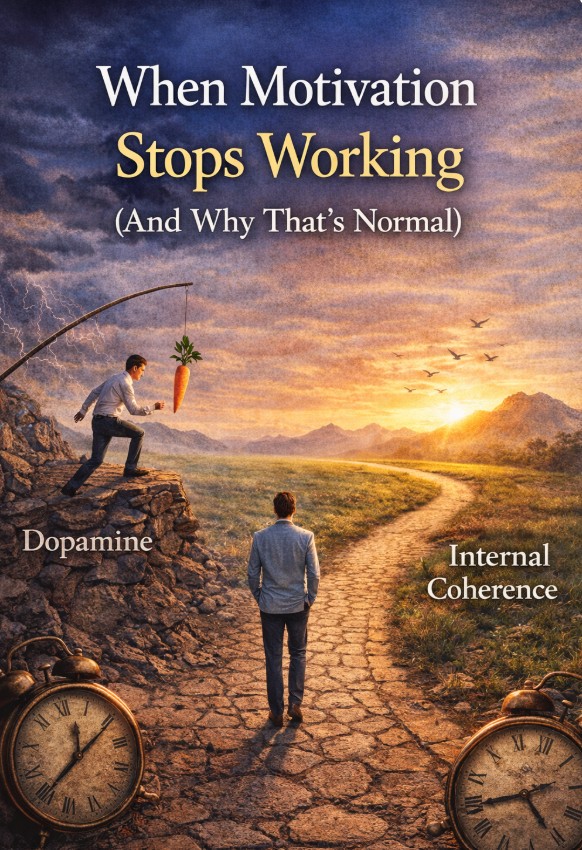
When Motivation Stops Working (And Why That’s Normal)
When Motivation Stops Working (And Why That’s Normal)
For most of our early life, motivation feels like the primary engine of progress. We set goals, chase rewards, push through resistance, and measure success by how hard we can drive ourselves. Motivation is fueled by urgency, ambition, comparison, and external milestones. It works remarkably well in our twenties and thirties, when the nervous system is wired for expansion, novelty, and proving.
Then, somewhere in midlife, the engine starts to sputter.
The same tactics that once worked—discipline, pressure, deadlines, hustle—begin to feel hollow or exhausting. You can still perform, but the emotional return is lower. The excitement fades faster. The internal resistance grows stronger. Many people interpret this as laziness, burnout, or a personal failure of willpower.
In reality, it’s a developmental shift, not a defect.
Dopamine vs. Coherence
Motivation is largely driven by dopamine, the brain’s reward chemical. Dopamine is excellent for initiating action, chasing goals, and sustaining short-term effort. It thrives on novelty, competition, and external validation. This is why early career growth often feels thrilling—new roles, new skills, new recognition.
But dopamine-based systems are inherently unstable. They require constant stimulation. Over time, the brain adapts, rewards feel smaller, and the same achievements no longer produce the same internal payoff. What once felt exciting begins to feel repetitive or empty.
Psychologically, midlife shifts the nervous system toward a different need: coherence. Coherence is the sense that your actions, values, identity, and direction actually fit together. It’s less about excitement and more about meaning. Less about chasing and more about alignment.
This transition is well documented in adult development research. As people age, motivation increasingly moves from external rewards toward internal meaning and purpose. Viktor Frankl’s Man’s Search for Meaning famously argued that humans can endure almost any circumstance if they perceive meaning in it—but struggle deeply when meaning is absent. Daniel Pink makes a similar case in Drive, noting that autonomy, mastery, and purpose eventually outperform rewards and pressure as long-term motivators.
Why Pushing Harder Stops Working After 40–50
In midlife, many people try to solve declining motivation by increasing pressure. More goals. More productivity systems. More discipline. More self-criticism.
This usually backfires.
The problem is not lack of effort. It’s misalignment. You are trying to power a meaning-based system with reward-based tools. It’s like pouring gasoline into a hybrid engine. The fuel no longer matches the machine.
At this stage of life, the psyche becomes less tolerant of activities that feel empty, misaligned, or purely performative. You may still succeed externally, but internally the energy leaks. The body resists. Procrastination increases. Fatigue deepens. The mind asks harder questions:
Why am I doing this?
Who is this actually for?
Does this still reflect who I am?
These questions are not symptoms of failure. They are signals of maturation.
Internal Coherence as the New Driver
Internal coherence becomes the primary source of sustainable energy in midlife. Coherence means your values, actions, identity, and direction are aligned. When coherence is high, effort feels lighter. Time passes more quickly. Resistance drops. Even difficult work feels meaningful.
When coherence is low, no amount of motivation can compensate.
This is why some people feel energized despite having demanding lives, while others feel depleted doing far less. Energy is no longer about how hard you push. It’s about how true the work feels to your internal compass.
The task of midlife is not to become more motivated. It’s to become more aligned.
What still fits?
What feels outdated?
What am I continuing mainly out of habit, obligation, or identity inertia?
These are coherence questions, not motivation questions.
The Relief Hidden in This Shift
One of the quiet gifts of midlife is realizing that your “lack of drive” may actually be intelligence, not failure. The system that once rewarded hustle is now asking for meaning. Your psyche is recalibrating toward depth instead of speed, coherence instead of intensity, authorship instead of performance.
Motivation doesn’t disappear. It transforms.
It stops being something you force and becomes something you feel when your life makes sense again. That’s not decline. That’s development.
And it’s exactly what should be happening.


